Divisions · Body Care (Stretch)
Body Care (Stretch)
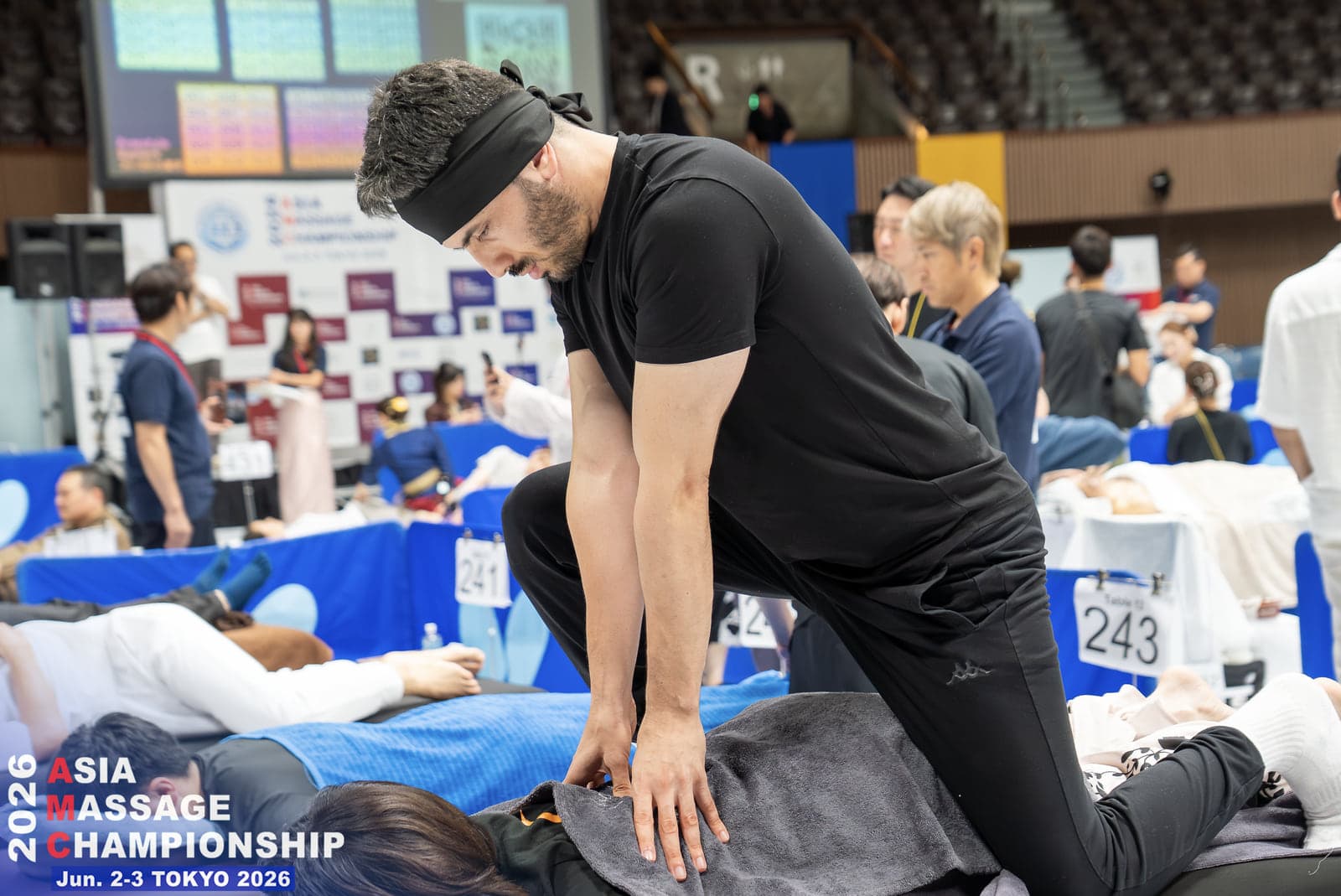
Clothed work built on compression, kneading and assisted stretching. Shiatsu, anma, tui na, reflexology and stretch-led bodywork all meet in this division.
- Dates
- 2027-05-26 – 2027-05-27
- Venue
- Yoyogi National Gymnasium, Second Gymnasium
What judges look for
Clothed and without oil, your reading of the body shows directly in the score.
- Assessment of range — what moves further after your work than before it
- Leverage — are you moving the body with weight and a fulcrum, or pulling with force
- Safe range — no joint taken beyond its range; do you wait for the client's breath
- Choice of depth — knowing where to go deep and where not to
- Communication — telling the client before you move them, checking for pain
How judging works, at a glance
Entry
Each person may enter up to two categories
Competition
Consultation, then a 30-minute treatment. Up to 15 at a time; fellow competitors take turns as recipients
Scoring
Judges score the 8 criteria, each out of 10
Totalling
The scores of the judges who gave the highest and the lowest are excluded; the rest are totalled and averaged
Placings
Placings are decided per category. Ties are broken in a set order
Who this division is for
Therapists working clothed day to day — bodycare, relaxation, manual therapy. Stretch-led and pressure-led practitioners compete in the same division. No national licence is required to enter the competition (treatment at the event is a competition performance, not professional practice).
Techniques competed in this division
From our world massage encyclopedia — the techniques that belong to this division. No school or lineage is prescribed; enter with the work you already do.
Thailand
Thai Massage (Nuad Thai)
タイ古式マッサージ(ヌアッドタイ)นวดไทย / นวดแผนโบราณ
Nuad Thai is the name used for traditional Thai massage. It can combine pressure over clothing and assisted stretching. Sen belongs to its traditional understanding of the body; practice varies by school and setting.
Pressure · Stretch · Herbal
Traditional healing systemTraditional massageView →Philippines
Hilot (Filipino Traditional Healing)
ヒロット(フィリピン伝統療法)
A name for traditional care carried forward in the Philippines. Practices may include manual work, herbs and family care. Knowledge and explanations among practitioners known as manghihilot vary locally; spa wellness massage does not represent the whole tradition.
Oil · Herbal · Heat · Pressure
Traditional healing systemView →Japan
Shiatsu
指圧指圧(しあつ)
A practice developed in Japan using pressure with fingers, palms and other forms of contact, often over clothing. Namikoshi and Masunaga traditions illustrate differences in teaching and understandings of the body; no single intensity or benefit defines them all.
Pressure · Stretch
Traditional massageClinical massageView →Japan
Anma
あん摩按摩(あんま)
A manual practice carried forward in Japan with historical connections to Chinese anmo. It combines kneading, stroking and pressure, often over clothing. The contributions of practitioners with visual impairments are an important part of its history.
Pressure · Percussion
Traditional massageView →China
Tui Na
推拿(すいな)推拿
Manual practices developed within Chinese traditional medicine, including pushing, grasping, kneading and rolling. They are described using concepts such as meridians and qi and blood. Introducing those concepts is separate from making medical judgements about symptoms.
Pressure · Stretch · Tool
Traditional healing systemClinical massageView →Aotearoa New Zealand
Mirimiri and Romiromi (Māori Bodywork)
ミリミリとロミロミ(マオリ伝統手技)Mirimiri / Romiromi
Mirimiri and romiromi are manual practices discussed within rongoā Māori in Aotearoa New Zealand. Accounts may emphasise concepts such as mauri and wairua and relationships with community. They should not be reduced to fixed light-versus-deep categories; practitioners’ own explanations matter.
Pressure · Wood · Tool · Herbal · Stretch
Traditional healing systemView →United States
Myofascial Release and Trigger Point Therapy
筋膜リリースとトリガーポイント療法Myofascial release / Trigger point therapy
Myofascial release is a name for approaches using sustained contact or stretching with attention to fascia. Trigger-point therapy is a related but distinct explanatory system. School-specific theories and practices should not be equated with established tissue changes or benefits for symptoms.
Fascia · Pressure · Stretch
Clinical massageModern bodyworkView →United States
Reflexology
リフレクソロジー(足の反射区療法)Zone therapy / 若石健康法
A practice applying pressure to feet, hands or other areas using the concept of reflex zones. Zone maps describe particular systems; they are not maps for diagnosing organs. Tools and ways of touch vary across schools.
Foot · Pressure · Tool
Modern bodyworkRelated therapyView →United States
Chair Massage (Seated Massage)
チェアマッサージ(シーテッド・マッサージ)On-site massage
Chair massage treats a clothed receiver seated forward in a purpose-built chair, working neck, shoulders, back, arms and hands in 10 to 30 minutes. David Palmer of San Francisco, drawing on his study of Japanese anma, systematised it as 'on-site massage' in the 1980s and designed the first dedicated chair in 1986. In Japan, short seated anma and shiatsu spread at the same time as 'quick massage', and the two together underpin the championship's chair category.
Pressure · Percussion
Modern bodyworkView →
Past winners
Therapists who placed in this division at previous championships.
Asia Massage Championship 2024
Body Care Massage Category
- 1Ryanmomihogushi RaiRai
- 2難波 舞首肩コリケアサロンSOFRA
- 3東 雄一リラクゼーションサロンL with U
Asia Massage Championship 2024
Stretch Category
- 1梶 智穂一般社団法人ユーファイ協会 代表理事
- 2福田 篤志Forme Body&Face恵比寿
- 3植松 幸司SSS札幌store SSS北見studio
Frequently asked questions
- Can I compete with a stretch-only session?
- Yes. The division does not prescribe technique. Stretch alone, or stretch combined with compression — what is judged is what reaches the person receiving it.
- Is there a dress code?
- The model is given clothing they can move in. You may wear the uniform you normally work in. See the competition rules for details.
Enter this division
33,000 yen (tax included) per entry. You can enter up to two divisions; each entry is charged separately.
Entries open at 19:00 JST (10:00 UTC) on Tuesday 27 October 2026 and close at 23:59 JST (14:59 UTC) on Monday 15 March 2027.
Enter the championship